
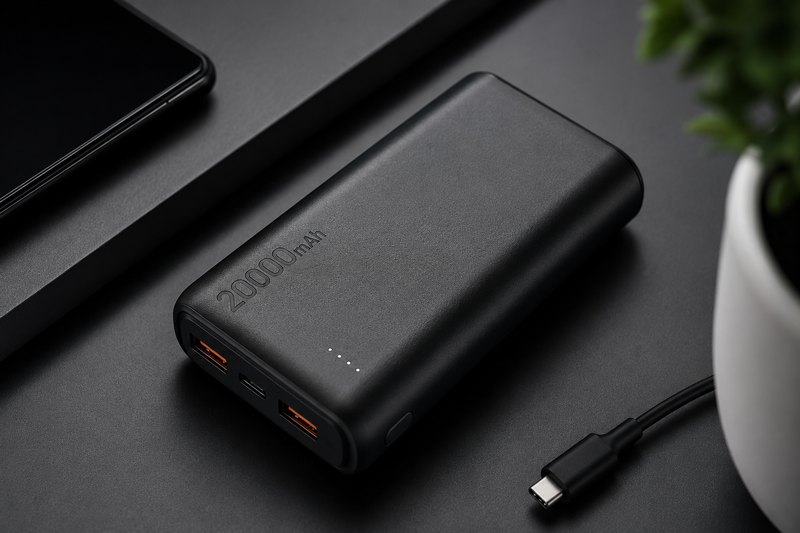
Actually, it is not simple and easy to locate the best power bank 20000mAh. Go to any shopping site, and type in those words, and you’ll find several hundred almost identical black rectangles, all offering high speed charging, multiple ports, and a small size. Few of them actually offer all of them and very few of the listings offer any information on what the 20000mAh means for your cell phone, tablet or laptop during actual use.
It’s an overview of the key features to check for in a 20000mAh power bank, why the model number on the packaging differs from the actual power output, and how to select the appropriate model for your travel, work or commute. When you’re finished, you will know more about which of these to acquire than most of the product pages that are selling them.
What will be the best capacity – 20000MAH?
Power banks come in all sizes, from small keychain chargers that have only 5000mAh of juice, to brick-shaped chargers that have either 30000mAh or 40000mAh of juice. The mid-range is 20000mAh and for most of the people it’s the most convenient number in the shelf.
In this capacity, a power bank is usually able to charge a modern smartphone 3 to 5 times, supply power for a tablet 1 or 2 times or charge a laptop partially, depending on the battery capacity of the device and the power bank’s charging efficiency. That’s enough for a full day’s drive, a long flight, a long weekend camping or working from a coffee shop and not looking for a way to relieve.
But it’s also the most common size that won’t necessitate extra paperwork to fly, something most owners don’t realize until they are standing in line at the airport security.
A number on the box does not necessarily equal a number you obtain!
This is the most often-misunderstood fact of all power banks and the reason for almost all the power bank 1-star reviews which say “this is not really 20000mAh.
The raw battery that is present in the device has a capacity of 20000mAh at the internal battery voltage – usually 3.7 volts. But the phone’s charging voltage is 5V and the power bank has to increase it to charge the phone, which means there will be some energy loss in the process that will be converted into heat. It uses a minimal amount of power during transfer from the circuit board, the display (if it has one) and the charging cable itself.
The end result is, that normally a power bank that is truly 20000mAh will only be able to give your phone the 65% to 75% of that, which is anywhere between 13000mAh to 15000mAh of power that you can charge your phone with. This isn’t necessarily a problem nor does it mean that the seller is trying to rip you off. It’s simple physics and each reputable brand power bank acts like this. But many lower cost, uncertified banks are even less; only about 50 percent of the bank’s rated capacity because of the quality of the cells or design of the circuit.
To sanity-check a listing: If the power bank can charge a phone with 5000mAh of battery to 100% five times, and the power bank itself is rated at 20000mAh, then you can assume it’s a puff piece and it’s not true. Closer to the mark would be four times (realistically three and a half times, due to losses).
Power and charging rate:
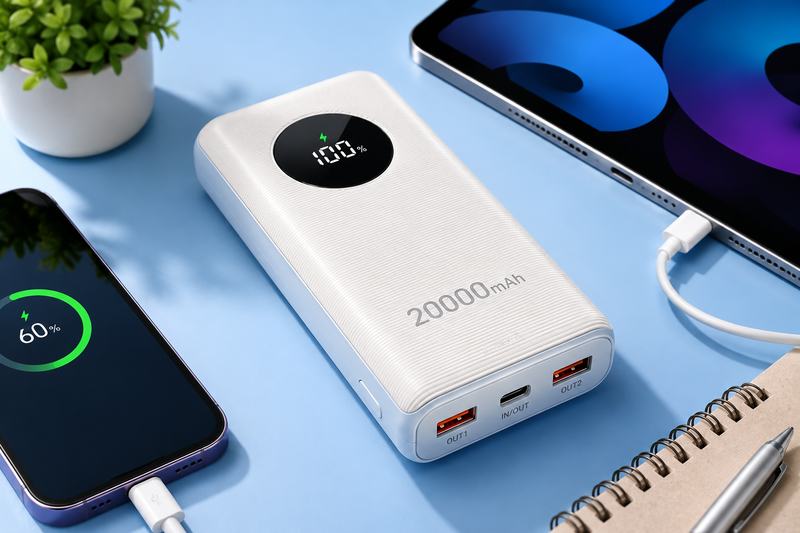
Capacity indicates the amount of energy that a power bank can hold. Wattage is a good indication of how fast it can provide this energy—and it is equally if not more important in terms of everyday usability.
Today almost all power banks follow the trend of using USB-C with Power Delivery (PD), or Qualcomm Quick Charge for older Android devices. The power bank’s watts are the number on the power bank box, ranging between 18W to 100W, which represents the maximum output of the power bank’s fastest port.
20W – 30W is just fine for cell phones and will be able to use almost all of the fastest charging of any cell phone today. In terms of laptop charging, look for a power bank that has a 65W output power or higher. Most of the time, anything at 100W will be able to charge most of the laptops with USB-C with the same speed as the wall charger.
The other significant distinction between a great and a mediocre power bank is its input wattage. A high output low input power bank will be able to charge things at 45W, but will take 4-5 hours to do so. If you desire to have the bank able to be reused quickly between sessions, look for an input rating of at least 18W or more.
Convenient tech-friendly features:
Power banks of 20000mAh are now available, having 2-4 USB-C and USB-A ports, allowing you to charge multiple devices simultaneously. Here are a couple of things to consider before buying:
Pass through charging is when you can charge both the power bank and device at once, which comes in handy if you’re at your desk and both the device and power bank are depleted. It may not be possible to fit some models and may damage the battery if used on a regular basis, so use it from time to time but not on a daily basis.
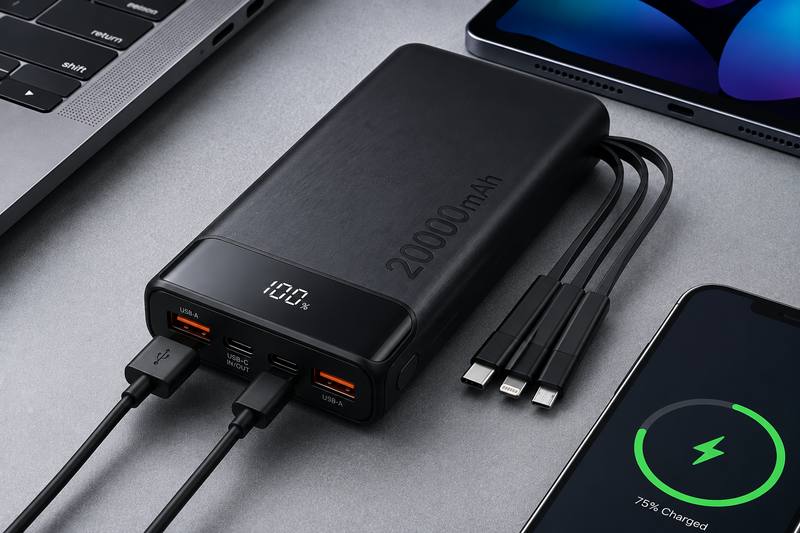
Unlike older 20000mAh phones, which often had detachable cables, built-in cables are now increasingly being integrated into smartphones, often as a foldable USB-C cable within the design of the phone. These can be very convenient in helping to reduce the number of cables you need to carry around but they are not generally replaceable if your cable fails, so it’s best to have one with a built-in cable and a port.
Some budget power banks will advertise the number of output ports, but have a restricted output in the second. If you want to charge a phone and earbuds or smartwatch at the same time, look for a combined wattage of the charging ports, and the wattage of the port that can charge your item at the fastest rate.
Safety and Certifications to consider:
Although lithium-ion batteries are safe when being used, there is a true danger of fire if the power bank is poorly constructed and experiences a thermal runaway. That is not to say that one shouldn’t buy a power bank ever, but one must never go light when it comes to a power bank, especially one with a capacity as high as this one.
Most name-brand manufacturers will have overcharge, over-discharge, short circuit and temperature protection circuitry which is required for the cells to be legally transported and sold under the UN38.3 standard. Another good second indicator is if the packaging is UL or IEC safety certified, it has been tested by an independent body.
Be wary of listings that are not branded or don’t have any cert numbers or listings that mention too much heat when charging. Assuming the 20000mAh power bank is well made, it will heat up during fast charging, but not be too hot to touch.
Yes, it is OK to use a 20000mAh power bank during flight:
There is a watt-hour limit for the power banks, not a milliamp-hour limit, for airlines and aviation authorities. The 20000mAh power bank has a standard cell rating of 3.7-volt and is equivalent to approximately 74 watt hours, less than the 100Wh power bank limit for all major carriers.
Larger power banks (100Wh to 160Wh) will require approval from the airline. This is not allowed on passenger aircraft if the battery is over 160Wh. Those figures are far from a standard 20000mAh unit and that is why this capacity continues to be the sensible choice for travellers who don’t want to deal with airline paperwork.
Power Banks are to be carried on and not in checked bags. A number of airlines have recently tightened up on these and have banned the charging of power banks from seat power outlets. Please consult your airline before travelling.
How to select the right power bank for you:
If you’re looking for an everyday use device, opt for one that is small, light, simple, and has only one USB-C charging port, between 20W and 30W. It’s about size and weight here, rather than watts.
If you are a frequent flyer, seek a narrow TSA approved design under 100Wh, and perhaps even have the cable be built-in and a display or indicator LED to keep track of the charge.
With remote workers who power up a laptop, wattage takes the top priority, with 65W or more and USB-C Power Delivery. When buying, be sure the laptop uses USB-C charging.
If you are using outdoors or for camping or emergency preparations, consider the following durability attributes: sturdy or watertight casing, built in flashlight, and, if available solar panel charging as an additional energy source.
If you are using more than one device, pay attention to the number of ports and the simultaneous output wattage and not the wattage of one port.
Here are some factors to think about BEFORE purchasing:
Check true watt-hour rating on unit (especially for flying). Check out the output wattage and the input wattage. In addition to the capacity, look for UN38.3 or UL/IEC certification. Make sure your number and type of ports match that of your devices. Check for fresh reviews that mention any overheating or capacity problems or failures following normal use.
FINAL THOUGHTS:
A power bank with 20000mAh is definitely one of the top tech gadgets to have on a daily basis as it’s just the right amount of charging power and portability. Often the best model for your needs is not the one that lists the highest number of watts on a specification sheet, but the one that reflects the watts or watts-amps you use on a daily basis, the charging speeds you need, the type of port and safety features that you utilize. With these checked, you’ll be able to easily cope with several phone changes with a good 20000mAh power bank.